WELCEOM TO TAI'AN CITY RUIHENG BUILDING MATERIALS CO., LTD OFFICIAL WEBSITE
Language:  ∷
∷ 
∷  ∷
∷ Geotextile-lined embankment dams represent a cost-effective and reliable solution for water retention, tailings storage, and flood control. Utilizing synthetic geomembranes as a primary barrier, these structures offer superior impermeability compared to traditional compacted clay cores. This article outlines the key materials, technical parameters, and a step-by-step construction sequence for a typical geotextile anti-seepage dam.
The primary sealing element is a geomembrane, typically made from High-Density Polyethylene (HDPE) or Linear Low-Density Polyethylene (LLDPE) due to their excellent chemical resistance, durability, and low permeability. A cushion geotextile is often placed beneath, and a protective layer above, the geomembrane.
Table 1: Typical Material Parameters for Geomembrane Liner System
| Component | Material | Key Parameters | Typical Value/Range | Function |
|---|---|---|---|---|
| Impermeable Liner | HDPE Geomembrane | Thickness Density Tensile Strength (MD/XD) Carbon Black Content Permeability Coefficient | 1.5 mm - 2.5 mm ≥ 0.940 g/cm³ ≥ 25 kN/m / ≥ 22 kN/m 2.0 - 3.0 % < 1 x 10⁻¹³ cm/s | Primary fluid barrier |
| Cushion/Protection | Non-Woven Geotextile | Mass per Unit Area Puncture Strength (CBR) Permittivity | 300 - 600 g/m² ≥ 2.5 kN ≥ 1.0 s⁻¹ | Protect geomembrane from puncture, provide drainage, stress relief |
| Anchorage | - | Anchor Trench Dimensions | Width: 0.8 - 1.2 m; Depth: 0.8 - 1.2 m | Secure geomembrane at crest and toes |
| Seams | - | Seam Type Peel Strength Shear Strength | Dual-Track Fusion Weld ≥ 30 N/mm (ASTM D6392) ≥ 40 N/mm (ASTM D6392) | Create continuous, monolithic barrier |
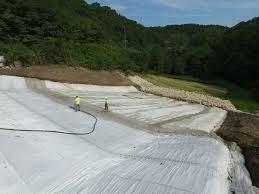
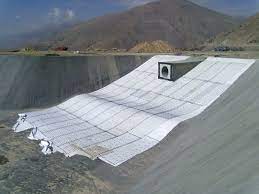
The success of the project hinges on meticulous preparation, careful installation, and rigorous quality assurance.
Phase 1: Subgrade Preparation
Excavation & Compaction: The dam's upstream slope and foundation area are excavated to stable, competent soil. All sharp objects, rocks >20mm, and vegetation roots are removed.
Grading: The subgrade is graded to design slope (typically between 2.5:1 to 4:1, H:V) and smoothed. Tolerances are strict, usually requiring no sudden changes >20mm over a 3m span.
Quality Control: The prepared subgrade is compacted to ≥95% of Standard Proctor Density and inspected for uniformity, smoothness, and moisture content.
Phase 2: Geosynthetic Installation
Cushion Geotextile Deployment: Rolls are deployed up the slope, with overlaps of 150-300mm. Temporary sandbags secure the sheets.
Geomembrane Deployment: Rolls are unrolled perpendicular to the slope's centerline. Panels are laid loosely to accommodate thermal expansion/contraction, avoiding tension during placement.
Scanning: The critical step. Adjacent panels (min. 150mm overlap) are joined using dual-track hot wedge welders on slopes and extrusion welders for details, patches, and repairs. Every linear meter of seam is tested.
Seam Testing: Non-Destructive Testing (NDT): Air pressure channel testing on dual welds. Destructive Testing (DT): Samples are cut from seam ends daily and tested for peel and shear strength in a lab.
Protective Layer Placement: Upon approval of all seams, a layer of cushion geotextile is placed over the geomembrane. Subsequently, a carefully placed free-draining soil layer (e.g., 300-500mm of sand/gravel) is placed via low-ground-pressure equipment to shield the liner from overlying rip-rap or fill.
Phase 3: Anchorage & Final Closure
Anchor Trench: The geomembrane and geotextiles are securely placed into a prepared anchor trench at the dam crest and upstream toe, backfilled with compacted soil.
Appurtenances: Pipes and structures penetrating the liner are sealed using pre-fabricated geomembrane boots and extrusion welding, followed by rigorous testing.
Cover Soil Placement: The final upstream cover soil or rockfill is placed in controlled lifts, ensuring no equipment directly operates on the exposed geosynthetics.
Phase 4: Quality Assurance & Documentation
Construction Quality Assurance (CQA) is continuous. A dedicated CQA team oversees material certification, subgrade preparation, scanning, testing, and final coverage. As-built drawings, welding logs, test reports, and repair records are compiled into a final project dossier.
Weather: Avoid installation during high winds, rain, or extreme temperatures.
Material Protection: Store geosynthetics away from UV exposure and damage.
Seam Integrity: This is the most critical activity. Only certified welders should perform this task.
Damage Inspection: The liner must be inspected for cuts or punctures both before and after the placement of the protective layer.
By adhering to specified material standards and a disciplined, monitored construction流程, geotextile-lined embankment dams provide a durable, high-performance hydraulic barrier with a service life exceeding decades.
COMPANY:TAI'AN CITY RUIHENG BUILDING MATERIALS CO., LTD
Contact:Nickle Nie
Tel:008615866038408
Phone:008615866038408
Email:nickle@rhgeos.com
Add:NO.3566 LONGQUAN ROAD,TAI'AN HI-TECH ZONE,SHANDONG PROVINCE,CHINA